
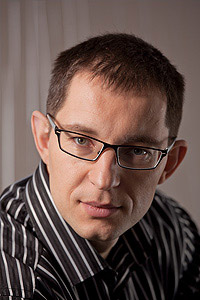
Nutrition advisor, lecturer, and author of an educational system and the ZOF application
Area of expertise: nutrition and nutrition education
Mgr. Martin Jelínek is the founder of the educational company ATAC and the author of a teaching system focused on nutrition and a healthy lifestyle. He graduated from the Faculty of Science at Masaryk University in Brno and has progressively combined sport, nutrition, education, and practical meal-planning work throughout his career.
In 2007, he launched the first intake of the six-month Nutrition Advisor course, which remains the most sought-after course in ATAC's portfolio.
Extensive experience in nutrition counselling, education, and practical meal planning.
Martin Jelínek's interest in nutrition began while he was actively involved in sport. He explored the effects of diet on health and the potential of dietary supplements to influence physical performance.
After graduating, he co-founded a company that produced and sold dietary supplements for athletes. He began providing advice to colleagues in the sports environment.
After ending his active sporting career, during which he pursued athletics, weightlifting, and arm wrestling, he gradually expanded his consulting work to include lectures and workshops.
In 2007, he launched the first intake of the six-month Nutrition Advisor course. This course subsequently became the cornerstone of ATAC's educational activities and remains the most popular of all the courses offered.
The educational system Martin Jelínek created and continues to develop guides students to explore the relationships and connections between diet and health, and to take a holistic view of nutrition.
Teaching draws on modern scientific knowledge while also introducing students to the principles and experience of traditional philosophical approaches, including macrobiotics, Ayurveda, and traditional Chinese medicine.
The aim is not to give students a single universal way of eating, but to help them think about nutrition in context and apply the knowledge they gain in real life.
The approach Martin Jelínek prefers and teaches is based on a varied and balanced selection of foods and respect for each person's individual needs.
An appropriate way of eating is therefore not fixed. It must be flexible and continuously adapted to the individual, their needs, and their situation.
This approach is at odds with universal or so-called “standardised meal plans”, which do not reflect the individual needs of a particular person. The courses therefore aim to educate people interested in a healthy lifestyle so they gain a comprehensive view of nutrition and can use individual pieces of information in context.
To make it possible to put the information gained into practice, Martin Jelínek created the ZOF teaching application, an integral part of the education system in the courses he runs. Students use it to turn theory into practice by creating recipes and meal plans.
The application makes it possible to track and assess key meal-plan parameters and continuously check how their composition affects the overall dietary pattern. This helps students learn to create diets that reflect an individual's needs and the given situation.
ZOF originated as an educational game and later developed into a standalone application. Its goal is not only to monitor dietary quality, but also to help users identify and correct errors in their meal plans.
Since 2010, Martin Jelínek has collaborated with Czech Television on the programme Under the Lid. Over the years, he has also appeared on other television and radio programmes, podcasts, and interviews focused on nutrition, health, and lifestyle.
He is the author of five books on nutrition and health and has long published professional and popular educational texts. Alongside his lecturing, he creates educational materials and develops a teaching system that connects theoretical knowledge with its practical use in meal planning.
His professional work therefore includes not only teaching students, but also writing, publishing, and media work aimed at making nutrition topics accessible to the wider public.
Professional articles on nutrition and a healthy lifestyle.
How does the course work, how much time does it take, what if you can’t keep up, and how long will you have access to the lessons? We’ve prepared brief answers to the most common questions prospective students have before starting and throughout their studies. For each topic, you’ll also find links to more detailed information.
Mgr. Martin Jelínek
Last professional review: 6 September 2026
People with very diverse experience and goals enroll in our courses. We welcome complete beginners, individuals who want to better navigate their own nutrition and their family’s diet, as well as professionals from related fields. Their starting knowledge and motivations for study vary, but they share a common interest in understanding nutrition more deeply.
Mgr. Martin Jelínek
Last professional review: 6 September 2026
Studying nutrition can mean something different to everyone. Some want to better understand their own diet and decision-making within the family; others are expanding their professional knowledge or exploring a new field of expertise. The common foundation is a better grasp of nutrition and the ability to apply the knowledge gained in specific situations.
Mgr. Martin Jelínek
Last professional review: 6 September 2026
The right choice of course depends primarily on what you want to learn and how you intend to use the knowledge you gain. A different type of study makes sense for someone who wants a comprehensive understanding of nutrition than for someone focused on sports, children, a specific health area, or professional application. Therefore, the easiest first step is to clarify what you expect from your studies and how you plan to use the knowledge you acquire.
Mgr. Martin Jelínek
Last professional review: 5 September 2026
We continually review and update course content to reflect the evolution of expert knowledge, changes in guidelines, and insights from teaching. Not every new study automatically means a change to a lesson. What matters is whether the new finding holds up in a broader context and truly changes how the topic should be explained or applied in practice.
Mgr. Martin Jelínek
Last professional review: 5 September 2026
One study day can take different forms depending on the course, the topic, and how much time you have at the moment. The core activity is working with a new lesson, which may be followed by a mind map, a practical assignment in ZOF, a practice test, or asking a question in the Q&A forum. Not all of these parts are included every day, and it isn’t necessary to complete them all at once.
Mgr. Martin Jelínek
Last professional review: 5 September 2026
Illness, holidays, work commitments, or family responsibilities can disrupt your original study plan. That is why you can set your own pace and open individual lessons according to your available time. If you need to take a break, you can simply continue later from where you left off, without having to abandon the course or start again.
Mgr. Martin Jelínek
Last professional review: 5 September 2026
Mind maps are one of the tools you can use in your studies to organize information and review the material later. They help capture the main topics, the relationships between them, and create a concise overview you can return to. Creating them is optional, and each student can choose the approach that suits them best.
Mgr. Martin Jelínek
Last professional review: 5 September 2026