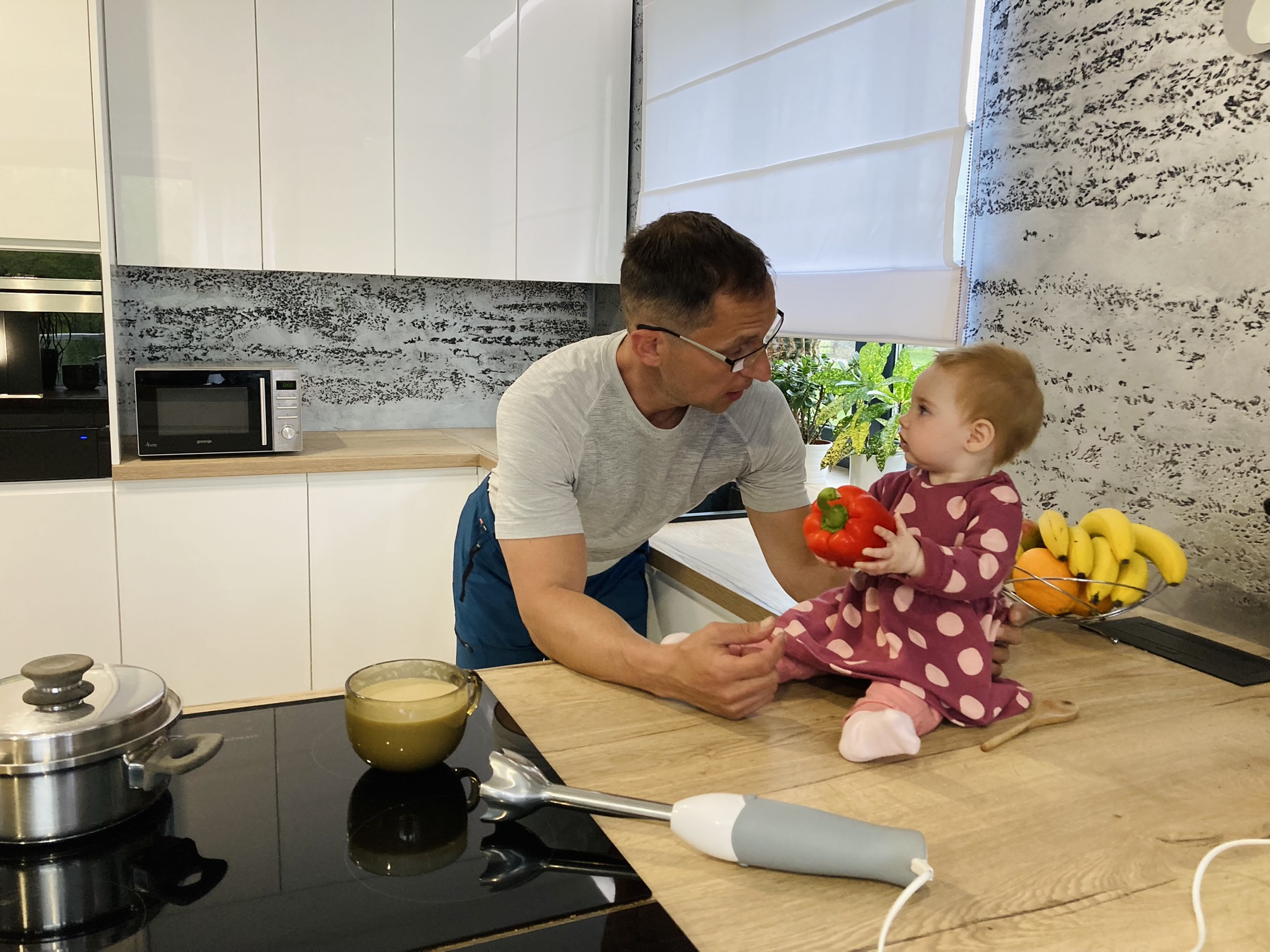
In every parent's life, there comes a moment when they are forced to deal with the transition to a non-dairy diet for their child. Introducing the first complementary foods is a significant change for the child and essentially for the parents as well, accompanied by a number of rules that unfortunately do not always agree.
The term "complementary feeding" refers to all solid and liquid foods except breast milk or formula milk. Generally, complementary foods begin to be introduced at a time when:
A) Breast milk or formula milk alone no longer meets the child's
nutritional needs (intake of
energy, macronutrients, and micronutrients),
B) The child's weight usually exceeds 6 kg,
C) The child is hungry after 8-10 breastfeeding sessions or after drinking 900-1000 ml of milk per day.
The introduction of complementary foods is also important for the child's psychomotor development. This means that the child must be able to sit independently or with support, maintain head stability, open their mouth when seeing a spoon, and after receiving a mouthful, not push it back with their tongue but swallow it.
Aside from these conditions, the age of the child is also considered when introducing complementary foods, taking into account the duration of breastfeeding or formula feeding. In exclusive breastfeeding, there is a consensus, recommending it for at least until the end of the 4th month (17 weeks) of the child's age. If the child is thriving, breastfeeding is appropriate for 6 months (26 weeks). This period is followed by the introduction of the first complementary foods. Conversely, if the child is not thriving on exclusive breastfeeding, or if they are fed formula, or if there is another reason for introducing complementary food, it is recommended to start with the first complementary foods between the 17th and 26th weeks of the child's age.
This timeframe has its reasons. Introducing complementary foods before 17 weeks or delaying them later than 6 months of age increases the risk of certain health complications—most commonly reported are feeding disorders, malnutrition, anemia, or food allergies. The situation is somewhat complicated by the consensus of a significant part of the expert community, which argues that non-dairy complementary foods should be introduced during the so-called window of immunological tolerance ("immunological window"), between the 17th and 26th week of life, that is no earlier than the end of the 4th month and no later than the end of the 6th month.
The transition to a non-dairy diet should not be abrupt, but gradual. When introducing complementary foods, breastfeeding or formula feeding should continue based on the child's needs up to 2 years or longer (due to milk being an important source of calcium, iron, and vitamin D).
In practice, the first complementary foods are often met with a child's reluctance to consume the dish. This behavior is partly related to the taste of the food. Children have a natural preference for sweet and salty flavors, and an innate dislike for bitter tastes. An infant can accept a new taste only after its 8th-10th exposure, so parents should be patient and encourage the child despite repeated reluctance.
The procedure for introducing different types of complementary foods looks as follows:
- It is typically recommended to first introduce single-ingredient vegetable foods.
The most common are carrots or potatoes, but peas, broccoli, cauliflower, later spinach, zucchini, turnip, etc., are also suitable. It is important to introduce each new food separately and repeatedly over 3-4 days to identify any potential allergic reactions.
- The transition to multi-ingredient concepts occurs during the first month of complementary feeding, provided there is good tolerance of individual ingredients.
It involves not only combinations of several types of vegetables but also meat and vegetable foods. The meat should be lean, preferably from organic sources, and no processed meats should appear in the diet. Due to better digestibility, white meat is preferred, but for higher iron content, it is recommended to combine it with red meat (in a 1:1 ratio). General recommendations for the amount of meat in a serving aim for around 20 g, from the 7th month 35 g, with a consumption frequency of six times a week, once a week should be replaced with cooked egg yolk. Gradually, one milk portion should be completely replaced by this meat-vegetable meal. Until the child can accept at least 150 g of complementary food, they should be supplemented with breast milk or formula.
- The second complementary food, which replaces another milk portion after the meat-vegetable combination, is unsweetened fruit puree.
The same rules apply as for vegetable complementary foods; i.e., new fruit types are introduced at 3-4 day intervals. When making it at home, it is advisable to monitor nutritional values, 100 g of puree should not contain more than 20 g of carbohydrates. The puree can gradually be mixed with plain yogurt.
- The next complementary foods introduced, which replace the third milk portion, are milk cereal porridges.
- Both gluten and gluten-free sources are used, always thoroughly heat-treated, non-whole grain. For commercially produced cereals, the type of grain they are made from and the age from which they can be given must be stated.
At least until the end of the 1st year of a child's life, dishes should not be seasoned or sugared. The child is fed with a spoon. Complementary foods should first be smoothly, then coarsely pureed, mashed, and finally chopped into pieces. Solid food should be introduced no later than in the 8th-10th month. This is also the period when it is appropriate to offer the child food for self-feeding (known as finger food = food to hold) - bread, fruit...
One of the new trends is called baby-led weaning, which skips feeding pureed food with a spoon and the child chooses what food and how they will consume it themselves. However, there are doubts about whether the child can receive enough necessary nutrients this way.
Parents often face the dilemma of whether to buy or prepare complementary foods at home. Both approaches have their pros and cons:
Homemade complementary foods allow for greater variation in flavors, but the risk may be the use of unsuitable foods or storage and preparation methods (ideal is cooking and baking, while grilling, frying, sautéing are unsuitable). Concerning commercial products, consumers often address the quality of the ingredients used and the price, but their undeniable advantage is the limited content of certain risky substances.
An important topic in infant nutrition is
allergens:
The incidence of allergic diseases continues to rise in the population. The most common manifestations of allergies in infancy are
food allergies (approximately 6-8% of infants) with a predominance of allergy to
cow's milk protein (CMPA - 1-3%). Others include allergies to
egg proteins,
gluten, as well as
soy and
nuts. Therefore, the significance of the
window of immunological tolerance between the 17th and 26th weeks of the child's life is being addressed, within which allergists recommend the first contacts with potentially allergenic foods (fish, egg whites, cow's milk, gluten). It is essential to introduce each new food individually over 3-4 days, monitoring for any undesirable reactions. Potential allergens are recommended to be introduced while the child is still at least
partially breastfed, and doses should be gradually increased.
It should be emphasized that this approach is primarily advocated by allergists. In the nutritional platform for fully breastfed children, it is usually recommended to start with the first complementary foods after the sixth month of age, introducing individual foods, including potentially allergenic ones, gradually. This also applies to sources of gluten, which some serious sources recommend introducing only after the 12th month (the initial dose should be up to 7.5 g of gluten-containing food per day, which corresponds to two teaspoons of wheat flour into vegetable complementary food or two biscuits into fruit puree, and is gradually increased until the full cereal portion is introduced).
In practice, a "compromise" approach can be encountered, combining the principles of both sides. In an effort to utilize the potential of the "immunological window," a small amount of individual foods, including potentially allergenic ones, is given to the child during exclusive breastfeeding. This way, it is possible to support the immunization process without suppressing the natural approach to infant nutrition.