
In nutrition, it is possible to find a study that seemingly supports almost any opinion. The existence of a single study alone does not mean that its conclusion is reliable or that general recommendations should be based on it.
When creating expert content, we therefore aim to consider the broader picture: the quality of the available evidence, whether the findings are replicated, how they fit with current scientific knowledge, and the extent to which they can be applied in everyday practice.
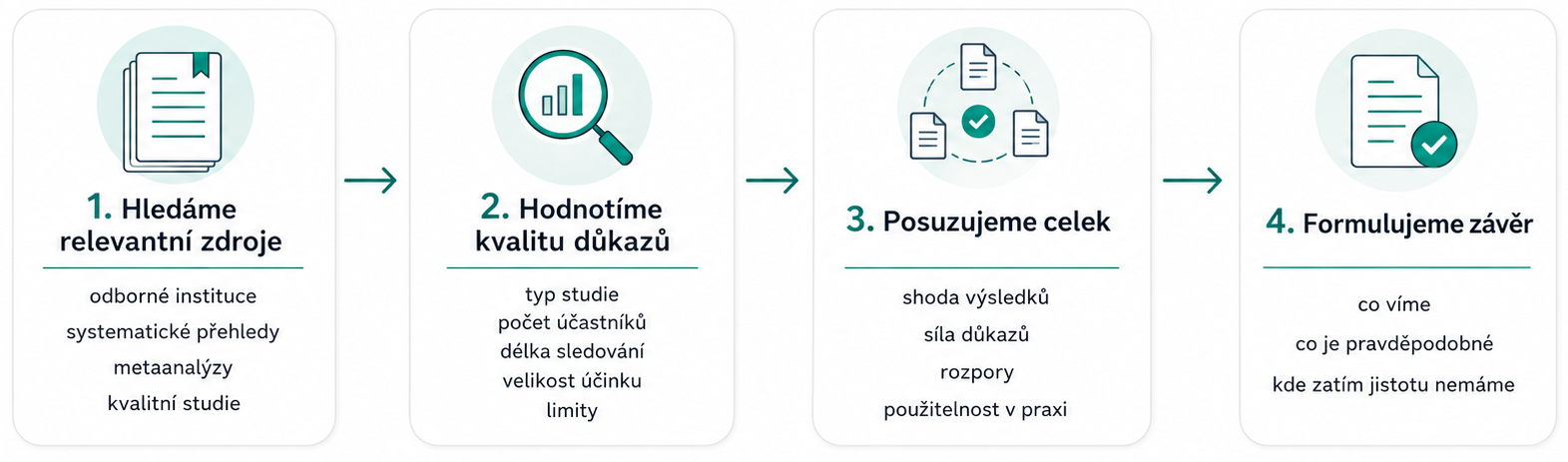
When preparing an expert article, we do not look for a single study that confirms a preconceived view. First, we seek to establish the overall state of knowledge in the area concerned.
We therefore give considerable weight to guidelines from respected professional and healthcare institutions, systematic reviews, and meta-analyses that evaluate the findings of many studies together. For more specific topics, we also draw on individual clinical, interventional, and observational studies.
Not all expert sources provide evidence of equal strength. When assessing them, we consider not only the result, but also factors such as the number of participants, study duration, study design, the magnitude of the observed effect, and whether other research has produced similar findings.
A large body of consistently replicated findings over time carries different weight from a small study with an interesting but as yet unconfirmed conclusion.
It is also important to us that the information addresses the question we are trying to answer. For example, a study conducted in elite athletes may not automatically apply to the general population, and the results of a laboratory experiment cannot always be directly translated into recommendations for an everyday diet.
Nutrition is a field where physiology, medicine, psychology, lifestyle, and individual differences all intersect. As a result, we have very good answers to some questions, while evidence is weaker for others, and in some cases a clear answer simply does not yet exist.
We consider it important not to obscure this distinction.
When something is well supported by evidence, we can state it with reasonable certainty. If research findings are limited or inconsistent, we use more cautious wording – for example, that the findings suggest a particular effect, that it may occur, or that it cannot yet be considered reliably established.

We also distinguish between findings from studies in people, claims based primarily on a biological mechanism, and experience from professional practice. A mechanism may be very interesting, but on its own it does not necessarily demonstrate that the same effect will actually occur in real life.
We therefore aim to avoid both overly confident claims and the opposite extreme, where the absence of absolute certainty would prevent us from saying anything at all.
Our aim is to express as accurately as possible how strong the available evidence is at any given time.
When working with sources, we consider how current they are, but the date of publication alone is not the only criterion of quality.
For fundamental physiological principles, older studies whose conclusions have been repeatedly confirmed may also be relevant. Conversely, in rapidly evolving areas – such as clinical guidelines, supplementation, or certain new therapeutic approaches – it is necessary to rely primarily on current sources.
If respected professional institutions issue differing recommendations, we do not automatically select only the one that best fits our perspective. We are interested in why their positions differ and what evidence underlies each recommendation.
Scientific knowledge evolves. What was the best available answer ten years ago may therefore not be the best answer today.
Even with careful expert work, errors cannot be completely ruled out.
If we identify a significant factual inaccuracy, we correct the text. If the change affects the article's scientific conclusion or recommendation, the article will be updated accordingly.
We do not regard the ability to revise a position when better-quality evidence emerges as a weakness, but as a natural part of expert work.
The expert content on the ATAC website is prepared by Mgr. Martin Jelínek. We therefore identify the author directly in articles and link to his dedicated profile, which provides information about his education, professional focus, and professional experience.
Depending on the nature of the topic, articles also include references to the expert sources used.
Artificial-intelligence-based tools can be useful aids, for example when searching for information, organizing it, or carrying out editorial work.
However, we do not consider output generated by artificial intelligence to be an expert source in itself.
Key expert information must be traceable to original sources, placed in the proper context, and assessed by a qualified professional.
Our goal is not to create the impression that science has an answer to every question or that all conclusions are definitive.
Above all, we want to distinguish as clearly as possible between what we currently know with reasonable confidence, what remains a subject of professional discussion, and what we do not yet know.
We consider this openness to be one of the essential conditions for trustworthy expert content.