
Author: Mgr. Martin Jelínek
Expertise: nutrition, education in nutrition
Last expert review: February 1, 2023

The life of an athlete is not all roses, as often portrayed in the media. The daily physical grind, mental stress, the effort to avoid injuries or not fall into a state of chronic fatigue are just the tip of the iceberg that most sports fans perceive.
Underneath, however, it looks a bit different. The need to perform at peak levels, at precisely the right moment, requires the coordination of a wide range of factors, including a well-structured diet. Modern research points to the fact that nutrition influences metabolism and health by several percentage points (lower tens of percent). We can consider a similar extent in relation to sports activity. The potential of this value is something every athlete should seriously contemplate. A sad fact is that in practice, the significance of this information eludes the majority, not only amateurs but unfortunately professionals as well.
What works very well is the business of sports supplementary nutrition. On the contrary, what almost doesn’t work at all (except in certain sports disciplines that cannot do without strict diets – a typical example is the fitness scene) is a systematic approach to nutrition. That implies a well-set long-term conception of food with regard to training load, where the main goal is to support performance and post-load recovery.
Every sport is unique and requires a special approach. This is also true for contact sports, which are additionally burdened by the necessity to control body weight due to weight categories. Everyone involved in this area knows how challenging it is to "make weight" - that is, to maintain a strict diet during full training, and if necessary before weighing, dehydrate. This discussion does not include the potential performance peak, when after achieving the required weight, the athlete enters the match exhausted and unable to perform at their trained capacity.
Even though there are known methods to achieve the result as efficiently as possible, i.e., without unnecessary performance reduction and risk to one's own health, it is astonishing how many athletes do not know or do this. Sports performance could look entirely different if participants knew and obeyed the basic rules related to this. There are many, and they just need to be cleverly pieced together to fit the individual needs of the athlete.
This theory sounds nice. However, it remains just theory until it is translated into real meals. So the next challenge for an athlete is the ability to realize the proposed dietary regime to the last detail. Not that it can't be done (examples of some athletes are sufficient proof), but it is often found that such diners dangerously approach the state of becoming literal slaves to food.
If you are a sports fan and are interested in what the preparation of a professional heading to the absolute top might look like, we have good news:

Lucka recently announced not one but two significant milestones in her career – the first being a match for the world title of the WBC organization (March 25, 2023), and the second, the transition from the professional ring to the amateurs with the aim of qualifying for the Olympic Games in Paris 2024.
And because Lucka doesn't do things by halves, she's also taken on the challenge of documenting her preparation for both events this year, particularly in the area of nutrition.
Don’t believe it?
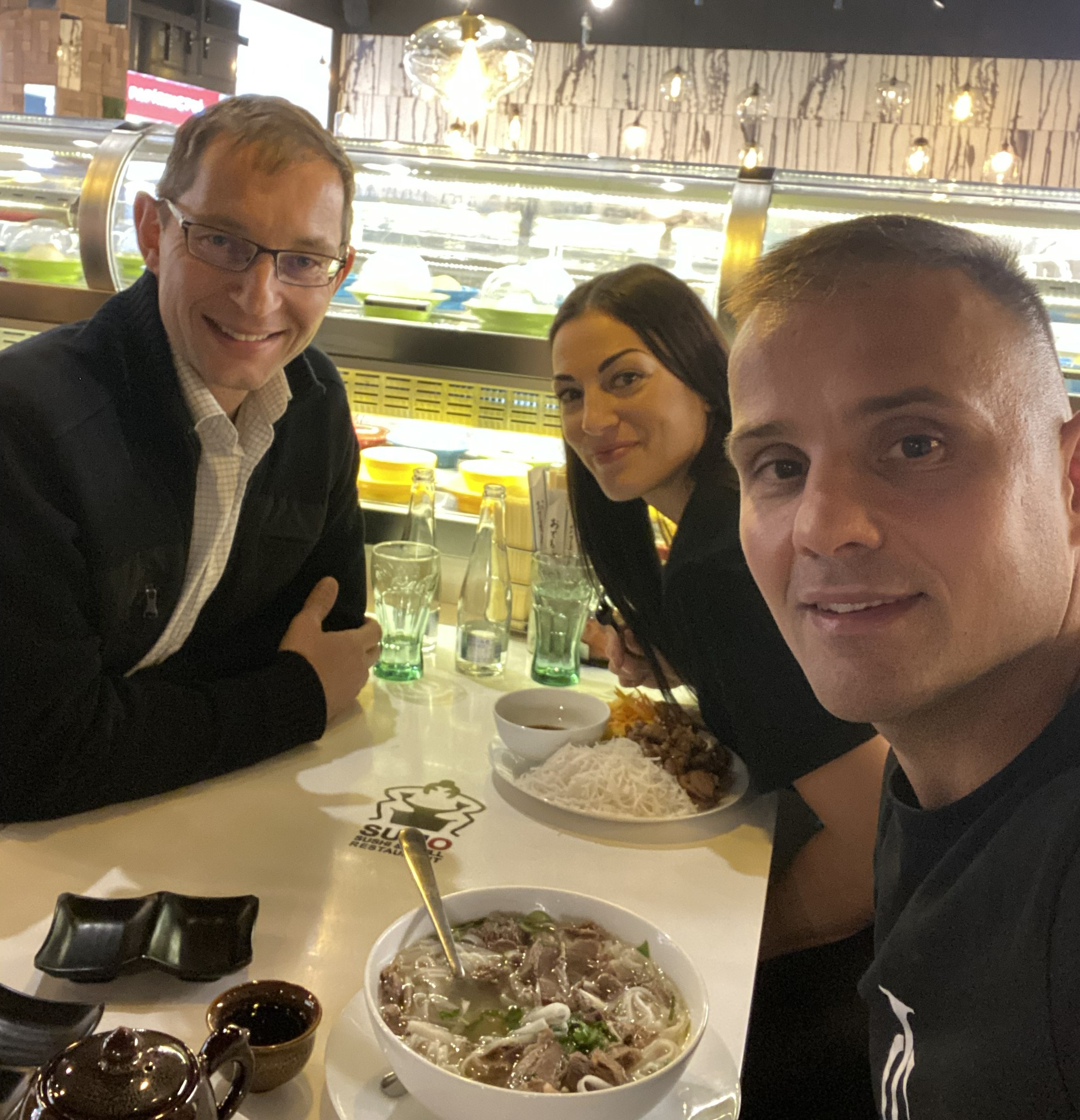
Since nutrition is my professional field, with a focus on sports nutrition, Lucka and I agreed that she will indeed let you take a peek into her dietary plans during her preparation for both sporting challenges. From start to finish. And she’ll hold nothing back.
The goal is to demonstrate:
- that even a top-level athlete can eat “normally,” without strict diets and loads of supplements.
- how to adjust the diet at various phases of preparation,
- how to manage pre-load and post-workout nutrition,
- options for eating in the “field,” that is, in situations where home kitchen facilities are unavailable,
- which supplements to prefer and which to avoid,
- how to fine-tune form for an actual match,
- the process of “making weight” before a match.
So what can you look forward to in the first half of this year?
- We will show what foods are the basis of the diet.
- Lucka will boast about her culinary skills in preparing recipes (she enjoys cooking and does it well).
- We will release the long-term diet plan for the different preparation phases.
- We will document the methods by which we calculate energy intake.
- We will consider ways to account for protein, carbohydrate, and fat intake.
- We will explain how to adjust the diet to lead to gradual performance improvement.
- “Reveal” pre-match weight loss methods (no, we will not dehydrate through the traditional method of sweating, there are significantly safer methods).
- We will enlighten you on the choice and use of supplements.
Simply put, we will demonstrate that Lucka is a professional through and through and leaves nothing to chance.
And because Lucka wanted her preparation to have an educational character, that means the action will not just serve as a guide for other athletes but will teach them, above all, to think constructively and highlight the thought processes leading to the resolution of individual situations, we will explain each step.
Where do we start?
The first peak of this season is the title match on 03/25/2023. Since Lucka is facing volume training, during which she needs to get into the weight limit of 57 kg besides supporting performance, to avoid unnecessary dehydration a week before the match, it is essential to do a bit of calculating from the start.
The condition for a successful start in the right direction is an analysis of body composition. We primarily need to know body weight, fat percentage in the body, and bone mineralization, which are the most crucial for setting the right dietary regime:
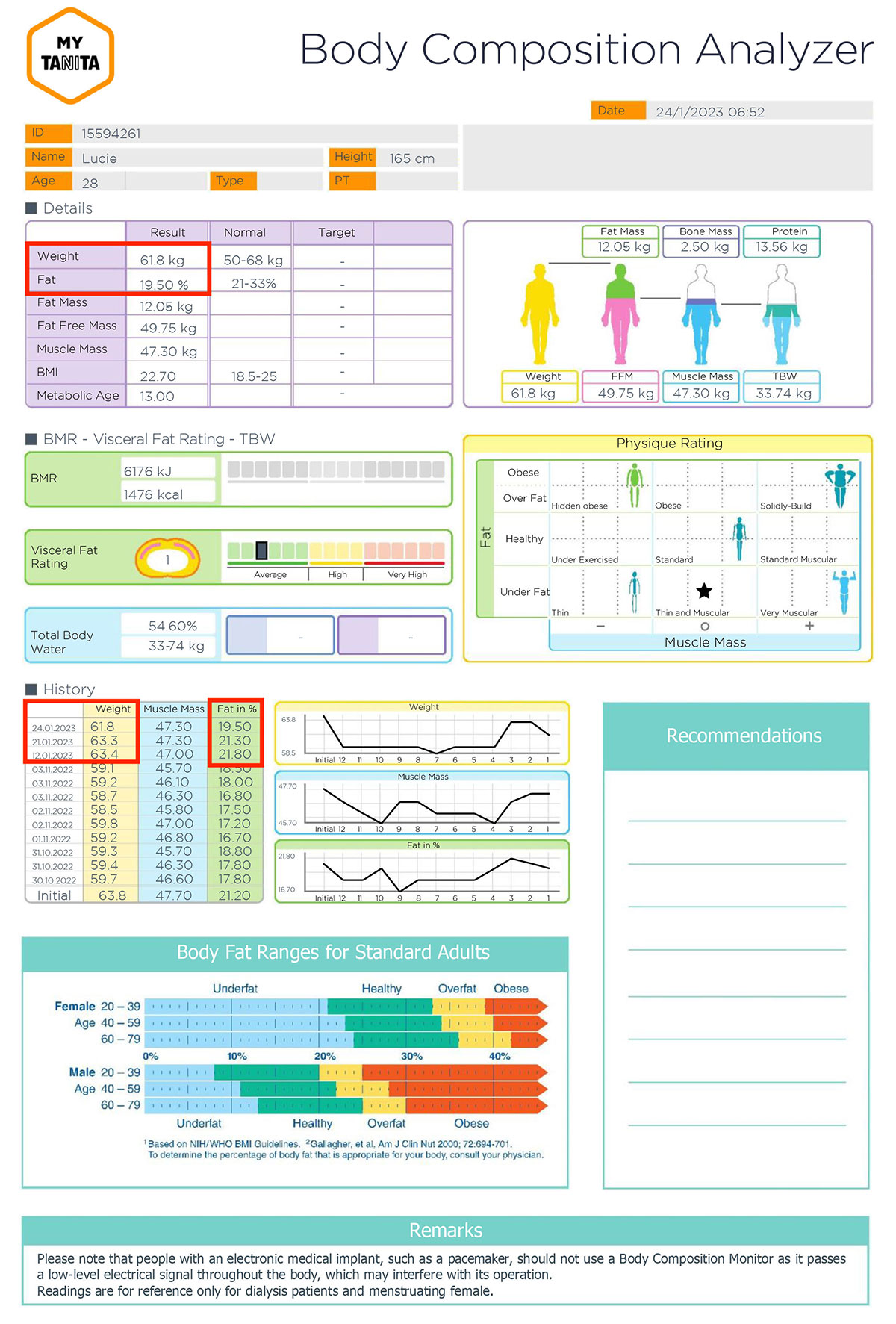
The results of each analysis can be read in various ways. Lucka started the preparation in combination with the dietary change on Saturday 21/01/2023, with measurements showing a body weight of 63.3 kg and a fat percentage of 21.3%. Notice from the analyses at the end of October and the beginning of November with significantly different values (it was preparation for a fight that was unfortunately canceled). So Lucka had two and a half months of free regime, during which her weight went up a few kilograms. Whether that is acceptable is debatable. However, the fact is that with professionals, this is a common standard where after a strict regime, the body and mind need to relax for a while, with the natural reflection being a change in body composition.
Back to the present. The last measurement is interesting, showing significant progress - a weight loss of 1.5 kg over three days, with a reduction in body fat percentage (I stress that measurements are always conducted in the morning on an empty stomach). The explanation is simple - Lucka added a dietary change to her full training. This significant shift is temporary, just a temporary reaction of the organism to a rather extreme dietary change (in future articles, we will explain that Lucka’s diet is not only not a nutritional extreme, but its core should rightly be seen as a natural approach to modern eating).
In our case, the good news is that the body fat percentage (21.3%, or currently 19.5%) provides a rather generous space for reduction. The standard presented limit, below which we won't want to go, is 12%, which significantly increases the risk of interfering with female hormonal regulation. We thus have 9 weeks to reduce less than 5 kg of fat. That is quite a lot for such a short period (0.5 kg per week), Lucka is facing quite a strict regime.
Another piece of good news is that there is no need to strive for a reduction in muscle mass, which can be problematic for athletes in terms of performance.
The new diet concept we set will be followed by Lucka without changes for the first half of volume preparation, i.e., 4 weeks. The goal is to give the body space to adapt to the new regime, which may, among other things, mean that it may not react by losing the expected 0.5 kg of fat per week. Even if the weight does not decrease as planned, we will make the first changes only after 4 weeks – the priority is always to give maximum performance in training, so we will avoid any experimental changes to the diet where we would risk negatively impacting the quality of training.
Body composition analysis will be done regularly once a week, so we will have an overview of the situation's progress.
Lucka trains 6 days a week (Mon-Sat), Sunday is rest (regenerative), three days a week are double-phase. Since we are in a situation where most training has an anaerobic character, we will avoid a low-carb concept where we would risk a lack of fast energy in training and increased fatigue. The diet regime will be based on 3 meals a day (breakfast, lunch, dinner), even on days off from training.
And the last - very important - thing:
Lucka and I have been collaborating for almost two years. In that time, we have managed to find a system that works, meaning the body responds with the desired effect. All the processes we will reveal are tried and tested. No experiments, no floundering, no stress from the unknown.
We go for a sure thing.
We are going for the title.
With this setting, we embark on an adventurous journey leading to the highest sports goals. We will regularly share updates from Lucka’s kitchen – follow and cheer on our best boxer!
Topics you can look forward to during Lucka’s preparation:
Lucka’s Shopping Cart
Supplement Selection
Energy Balance
How We Count Proteins
Carbohydrate Sources
Fats in the Kitchen
Fiber – The Enemy of Athletes?
Hydration
Coffee in Sports
Unexpected Challenges
Dehydration before a Match
Number of portions per day
Breakfast
How to Influence Muscle Tone
Stimulants in Nutrition
Kitchen Work
Legumes in Sports Nutrition
Field Nutrition
Pre-Training Meal
Anabolic Window
Lucka’s Ace in the Hole
Pre-Match Diet
Mgr. Martin Jelínek
Founder of NutriCourses, lecturer and author of the educational system in the field of nutrition. He has been systematically engaged in nutrition education since 1999. He is the author of the educational application ZOF and professional publications focused on nutrition and a healthy lifestyle.