
Author: Mgr. Martin Jelínek
Expertise: nutrition, education in nutrition
Last expert review: February 7, 2023

There are many opinions and approaches to the use of dietary supplements, and this is even more true in sports. The fact is that a top athlete cannot do without supportive supplementation. Not so much for performance enhancement, which is a chapter in itself.
There are two significantly more important reasons:
1. The first is the need to support the process of post-exercise recovery.
2. The second is the harmonization of the functions of the immune system as a prevention of the onset of diseases that would prevent training or complicate the potential to deliver optimal performance in the match itself.
The market offers a plethora of different types of products in varying quality, whose manufacturers and sellers strive to present only the best possible effects. It's no wonder that an uninformed consumer may struggle to orient themselves and choose the right one (or ones), ensuring their overall intake does not exceed reasonable limits.
The not so favorable news is that no one knows what "reasonable limits" truly are.
The good news is that it is possible to define several basic rules, following which we can maximize the benefits of supplementation.
So, the rules first:
1. It is important to use substances that the athlete genuinely needs.
This entails:
A) Nutrients that for various reasons cannot be supplied by diet.
B) Substances that meet the needs of metabolism in the context of the training cycle they are undergoing.
C) Keeping emotions in check and not striving to use "everything" at any cost.
2. It is necessary to choose products that do not risk a positive doping test.
This likelihood is quite low today, yet it still exists. It is wise to avoid some stimulants primarily and prefer products from reputable companies (which, of course, raises the question of how to recognize them).
3. It makes no sense to experiment (this applies to preparation for a major competition) but rather to go "for sure."
It is advantageous to provide the body with essentials from which more can be garnered in the aggregate than from short-term manipulation using untested substances.
4. It is necessary to learn to discern quality in individual products.
This is broad and unfortunately not always a straightforward topic. If the user does not complicate matters unnecessarily, they can find a match between their own expectations and the actual effect.
5. It is reasonable to accept the fact that a significant role (if not crucial) in the effects of selected and used products is played by the athlete's psyche.
We know that substances act not only biologically but also psychologically (a typical example is the placebo effect). It is thus common that even less quality or effective preparations can show an interesting effect. The same "intensification" of effect can be achieved with high-quality supplements.
Most athletes approach supplements—to their great detriment—in exactly the opposite way. They often fall for either a personal recommendation in their surroundings or a marketing campaign by the seller, resulting in aimless use of a disparate mixture of various products.
The fact is that Lucka went through the necessary "testing" phase in the past in the form of using a plethora of products that are not absolutely necessary for her sport, often proving to be counterproductive.
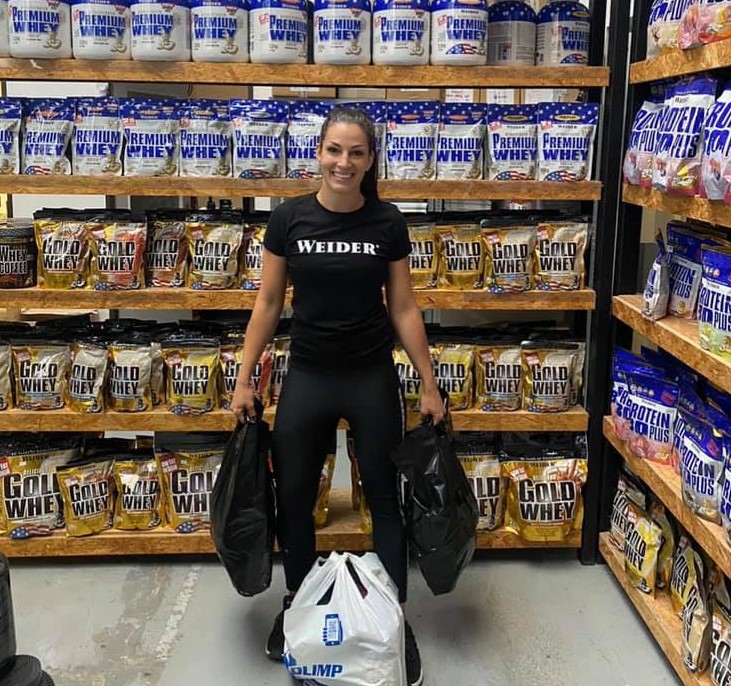
In the current preparation phase, we aim to keep supplementation "grounded" for various reasons, focusing only on the most important directions. We proceed as follows:
1. First, we address substances that we know Lucka absolutely needs.
Blood tests indicate a deficiency in iron, so along with dietary adjustments, we improve the situation with supplementation. For iron supplements, it's better to prefer organic forms, which offer much better bioavailability and at the same time do not burden the digestive tract.
2. Next are nutrients that we know we cannot ensure in the sufficient quantity through the diet.
Here we proceed logically:
- High physical and mental exertion is a source of excessive oxidative stress, which we counteract with the intake of antioxidants. We've chosen:
A) Vitamin C (1000 mg daily in multiple doses), which, among other things, supports iron metabolization,
B) Vitamin E (200 IU daily).
- Another substance is also a vitamin that has been increasingly discussed in recent years due to its significant deficiency in the majority of the population. It is calciferol (vitamin D).
Since the opportunity for a title match came unexpectedly and there was no time to check this substance's blood level, its dosage is prophylactic (2000 IU daily).
- Surprisingly, the list of vitamins isn't over yet.
The next step in our considerations is to target the support of energy production, which is co-participated by the B vitamin complex.
These too cannot be provided in necessary doses and with proper bioavailability on a regular plate, so supplementation is around 300% of their reference values.
Theoretically, we could cover the aforementioned spectrum more easily in the form of a single multivitamin. However, because Lucka spends 5-6 hours a day at the sports facility, the demand for these nutrients is too high (multivitamins generally do not cover this), plus most of the above-mentioned substances are taken in multiple doses throughout the day.
- Intense exertion leads to increased muscle tone, which in multi-phase training often leads to cramps.
We initially tried to address this by adjusting the diet to increase the intake of magnesium and adjust its ratios with calcium (both elements affect neuromuscular coordination), and after exhausting the potential of diet, switched to using standalone magnesium (in organic form, maintaining doses around 400 mg daily).
- We also target the support of joint and connective tissue nutrition.
This area is addressed first by ensuring sufficient protein in the diet and adequate intake of vitamin C, which is foundational for collagen production in the body. Only then does it make sense to include effective specifics. We've chosen a combination of glucosamine with boswellia, which is significantly more advantageous and basically more meaningful than any form or source of collagens. The advantage of boswellia is its significant anti-inflammatory effects in joint tissue. Glucosamine intake is standard, ranging around 1500 mg, divided into 2-3 doses.
- Another substance is carnitine.
Despite some controversies that have followed it for over 20 years, we are convinced that its supplementation is particularly beneficial in supporting fat tissue reduction. Another argument is the fact that Lucka consumes meat, its richest source, in minimal amounts. Dosage is around 1000 mg before more intense training.
- A specific group is adaptogens.
Their undeniable advantage is the ability to support the function of systems in the body without depleting them. There is a whole range of adaptogenic herbs with various effects, and our choice fell on rhodiola and Siberian ginseng. We use them regularly, with doses increasing towards the match date.
- Since boxing training is demanding, it is occasionally necessary to slightly stimulate the body and mind. We have selected a mix of stimulants, mainly based on caffeine, synephrine, and extracts from some herbs (turmeric, pepper...).
It is crucial to understand the term "occasionally" correctly. The body can develop tolerance to their effect, and with regular use, they lose effectiveness. Therefore, Lucka uses them only exceptionally, before demanding sparring sessions.
- The last specific is tribulus.
It is an extract from the puncture vine, which supports testosterone production. We try to work with it "smartly," cycling its dosage depending on the intensity of exertion and simultaneously increasing doses towards the match date.
This list is practically complete. The product spectrum isn't the narrowest, yet athletes commonly tend to take significantly more supplements. As stated, we strive to stick to only the most essential. In this area, the rule "more = better" does not apply, as we can never predict how the metabolism will react to an unreasonably broad spectrum of various substances with an unreasonably high degree of their biological availability. The goal is to establish a sustainable system, support performance and recovery, and simultaneously fine-tune form towards a fixed date.


Mgr. Martin Jelínek
Founder of NutriCourses, lecturer and author of the educational system in the field of nutrition. He has been systematically engaged in nutrition education since 1999. He is the author of the educational application ZOF and professional publications focused on nutrition and a healthy lifestyle.